 By
By Ruto’s Singapore Plan: Kenya’s Bold Journey Toward First-World Status
Kenya stands on the edge of a major transformation. President William Ruto recently unveiled an ambitious economic blueprint aimed at lifting the country to first-world status. Many are calling it a “Singapore-style model” because of its focus on infrastructure, industrial growth, and aggressive human capital development.
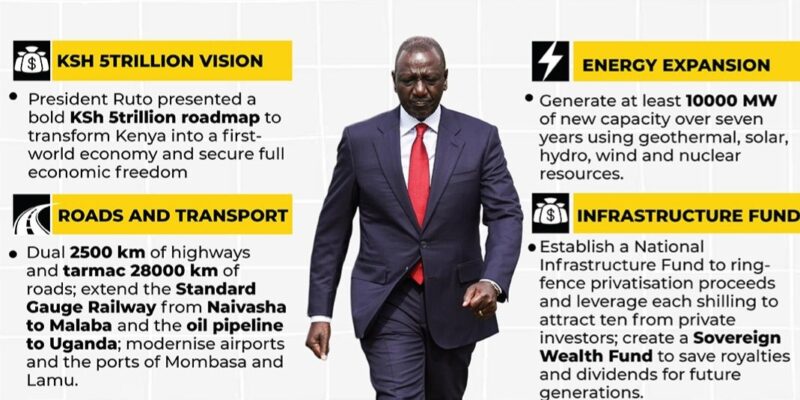
The plan carries a huge price tag — KSh 5 trillion — but it also promises to reshape Kenya’s economic future. It outlines clear areas of focus, including roads, transport, energy expansion, irrigation, education, research, and a new infrastructure financing model.
In this article, we break down the details of this roadmap and examine why the proposal matters for Kenya’s development path. We also look at how each pillar could affect the country’s economy, its workforce, and its global competitiveness.
1. The KSh 5 Trillion Vision: A Blueprint for Economic Freedom
The foundation of the plan is a KSh 5 trillion investment agenda. President Ruto positions it as a roadmap for Kenya to secure economic freedom and transition from a developing country into a modern, globally competitive economy.
The proposal emphasizes industrial productivity, strategic investment, and a shift from consumption to production. Instead of depending on traditional aid financing, the plan seeks to generate revenue, attract large-scale investment, and free Kenya from debt-driven development models.
If implemented successfully, this investment could trigger sustained growth and help the country scale up industries such as manufacturing, transport, technology, agriculture, and energy.
However, achieving a KSh 5 trillion target requires strong political will, financial discipline, private-sector involvement, and efficient execution. Kenya will also need long-term stability to sustain progress over the next decade.
Even so, the vision signals intent. And intent matters.
2. Roads and Transport: A New Era of Connectivity
A major pillar of the plan is infrastructure development. Roads and transport receive significant attention, and for good reason: efficient movement drives trade, lowers production costs, opens markets, and stimulates investment.
The transport component aims to:
-
Construct dual 2,500 km of highways
-
Tarmac 28,000 km of additional roads
-
Extend the Standard Gauge Railway from Naivasha to Malaba and then into Uganda
-
Modernise airports and upgrade the ports of Mombasa and Lamu
This scale of expansion could radically change Kenya’s national and regional logistics network.
Better highways mean stronger supply chains, easier cargo movement, and improved inter-county connectivity. Extending the Standard Gauge Railway could boost regional trade and cut the cost of transporting goods across borders. Upgrading airports and seaports may open broader markets for tourism, exports, and logistics investment.
If executed well, the transport agenda could raise Kenya’s standing as a commercial gateway for East and Central Africa.
3. Energy Expansion: A Path to Industrial Power
Energy remains one of Kenya’s biggest development challenges. High tariffs, unreliable supply, and aging infrastructure limit industrial growth.
To confront this, the plan targets:
-
At least 10,000 MW of new power capacity within seven years
This expansion will rely on geothermal, solar, wind, hydro, and even nuclear energy sources.
More power means more factories, more digital infrastructure, and more industrial zones — which in turn means more jobs and higher productivity. It also positions Kenya to compete globally in clean energy production and technology investment.
If the energy sector improves rapidly, Kenya could shift from an energy-struggling economy into a major renewable-energy leader in Africa.
4. Irrigation Projects: Reclaiming Food Security
The roadmap places agriculture at the centre of national growth. The irrigation strategy proposes:
-
50 mega dams
-
200 mini dams
-
1,000 micro dams
-
2.5 million acres under irrigation
This would replace reliance on rain-fed farming, which remains unpredictable and vulnerable to drought.
More irrigation means more food production. It also reduces import pressure, stabilizes prices, and strengthens rural incomes.
If implemented, this shift could transform Kenya’s agricultural economy. It could turn hunger hotspots into major food belts and increase export capacity for crops such as grains, vegetables, and fruits.
Agriculture still employs more Kenyans than any other sector. Therefore, investment in irrigation is investment in people.
5. Infrastructure Fund: Unlocking Investment Capital
Funding large development plans remains a challenge. To address this, the proposal includes the creation of:
-
A National Infrastructure Fund
-
A Sovereign Wealth Fund
The National Infrastructure Fund would ring-fence privatization proceeds and attract private investment. At the same time, the Sovereign Wealth Fund would manage royalties and dividends from national assets, securing long-term savings for future generations.
This financing model aims to reduce debt dependency, increase investor confidence, and ensure accountability.
If managed effectively, it could provide a sustainable stream of revenue for major projects and reduce pressure on taxpayers.
6. Human Capital Investment: Expanding Education and Research
The future of any modern economy depends on its people. To build first-world competitiveness, Kenya must expand education, science, and research capability.
The plan proposes to:
-
Raise the education budget from KSh 490 billion to KSh 700 billion
-
Increase research funding to 2% of GDP
More funding means better classrooms, improved teacher training, stronger learning outcomes, and broader access to education. Boosting research spending also supports innovation, technology development, and intellectual capital.
Countries like Singapore, South Korea, and Finland invested heavily in human capital before achieving first-world status. Kenya is now signaling a similar direction.
Why This Plan Matters for Kenya’s Future
Ruto’s Singapore-style roadmap arrives at a defining moment. Kenya faces rising living costs, unemployment pressure, debt repayments, and global competition. But the country also holds massive potential.
With the right infrastructure, Kenya can unlock trade opportunities across Africa. With enough energy, Kenya can support industrial growth. Moreover, with heavy investment in irrigation, Kenya can secure food stability. Last but not least, with strong human capital investment, Kenya can build a knowledge-based economy.
The plan is bold, expensive, and complex. Yet progress rarely happens without ambition.
Challenges Ahead
Even with clear goals, Kenya must overcome:
-
High borrowing costs
-
Unpredictable revenue flow
-
Project management risks
-
Corruption concerns
-
Political division
-
Global economic shocks
Execution will require transparency, efficiency, strong leadership, unity, and accountability.
However, if citizens and institutions align behind the vision, Kenya may set a new development path for the region.
Conclusion: A Defining National Vision
Ruto’s Singapore Plan captures a simple idea: Kenya does not want to remain a developing nation forever. It wants to rise.
The roadmap, powered by massive investment and sectoral transformation, points toward that direction.
Whether Kenya reaches first-world status will depend on execution, stability, and national support. But the message is clear — the country is thinking bigger, building faster, and planning for generations ahead.
Kenya has dreamed of economic freedom for decades. This plan gives shape to that dream. Whether it succeeds will define the country’s future.
What's your reaction?