
 By
Grace City: Murang’a Women Representative Aspirant and Her Manifesto
Murang’a County continues to look for leadership that can address the needs of women, young people, families and local communities. Among the political figures preparing for the 2027 General Election is Grace Nduta Wairimu, popularly known as Grace City.
Grace City is the elected Member of the County Assembly (MCA) for Kanyenya-ini Ward in Kangema Constituency. She has also expressed interest in contesting the Murang’a County Women Representative seat under the Democracy for the Citizens Party (DCP).
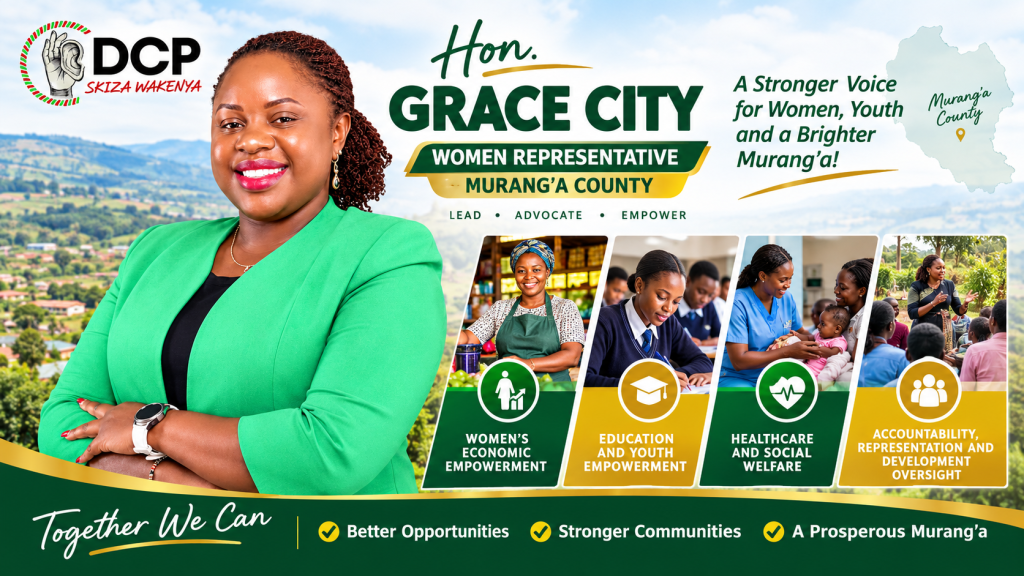
Her proposed agenda highlights four key areas: women’s economic empowerment, education and youth empowerment, healthcare and social welfare, and accountability in public representation.
These priorities touch on issues that matter to households across Murang’a County. However, their impact will depend on clear plans, effective representation and measurable results.
Who Is Grace City?
Grace Nduta Wairimu, popularly known as Grace City, is a Kenyan politician who represents Kanyenya-ini Ward in the Murang’a County Assembly.
Her experience in county politics gives her an understanding of the relationship between elected leaders, local communities and public service delivery. As an MCA, she participates in county legislative processes, represents residents and contributes to oversight of county government.
Her public engagements have included education and community healthcare issues. Kenya News Agency reported on her involvement in bursary distribution in Kanyenya-ini, where she encouraged parents to support their children’s education.
She has also spoken about healthcare access in her ward. During the commissioning of Karurumo Dispensary in 2023, she highlighted the importance of bringing medical services closer to residents.
These experiences provide useful context for examining her interest in the Women Representative position. Nevertheless, her record as an MCA should be distinguished from the promises she may make for a future parliamentary role.
Grace City’s Political Ambition in Murang’a County
The Murang’a Women Representative position provides an important platform for advocating for women, young people and vulnerable communities.
Grace City publicly expressed interest in the seat in September 2025, according to People Daily. Subsequent reporting in 2026 has continued to identify her as an aspirant for the 2027 General Election.
Her political affiliation is associated with the Democracy for the Citizens Party, commonly known as DCP, whose slogan is “Skiza Wakenya”.
The party promotes themes that include accountable leadership, economic opportunities and equitable development. Grace City’s own manifesto, however, must explain how she intends to translate these broad principles into practical action for Murang’a residents.
The election will provide an opportunity for voters to compare the candidates’ experience, policy proposals and ability to represent the county’s interests.
1. Women’s Economic Empowerment
Women’s economic empowerment is the first pillar of Grace City’s published agenda.
Across Murang’a County, women participate in agriculture, retail, small businesses, cooperative societies and other economic activities. Many also carry significant family responsibilities.
Supporting these women requires more than general promises of empowerment. It requires practical measures that help them increase their incomes, build sustainable businesses and access economic opportunities.
Potential areas for action include financial literacy, entrepreneurship training, business mentorship, access to markets and support for women-led enterprises.
Women working in agriculture could also benefit from initiatives that improve market access, value addition and business management skills.
For small traders, practical training and information about available enterprise programmes could help them grow their businesses.
As Women Representative, Grace City would have a parliamentary platform to advocate for policies and national programmes that support women. She could also engage relevant ministries, agencies and development partners to promote initiatives that address the needs of women in Murang’a.
Her detailed manifesto should explain which programmes she intends to prioritise, how beneficiaries would access them and how she would measure their impact.
2. Education and Youth Empowerment
Education and youth empowerment form the second pillar of Grace City’s agenda.
Young people need access to quality education, relevant skills and opportunities to earn a living. At the same time, families facing financial difficulties need support that helps children remain in school.
Grace City’s public engagements have included bursary-related activities in Kanyenya-ini. Her proposed countywide agenda could build on this experience by advocating for improved access to educational opportunities.
One priority is supporting vulnerable learners. Bursaries, scholarships and appropriate education assistance can help deserving students continue their studies.
Another priority is technical and vocational education. Practical training in areas such as information technology, electrical installation, agribusiness, construction and other market-relevant skills can help young people prepare for employment or self-employment.
Digital literacy also deserves attention. Young people who understand computers, online communication, digital marketing and other relevant technologies can access a wider range of learning and business opportunities.
Furthermore, mentorship programmes can help students make informed career choices and develop confidence.
Grace City’s manifesto should clarify how she intends to advocate for these opportunities, particularly for young people from low-income households and communities with limited access to training.
3. Healthcare and Social Welfare
Access to healthcare is another important issue for families across Murang’a County.
Although county governments manage many local health services, the national government also plays a significant role in health policy, financing and national programmes. Effective representation requires cooperation between the two levels of government.
Grace City’s experience as Kanyenya-ini MCA has brought her into contact with local healthcare concerns. In 2023, she commented on the importance of Karurumo Dispensary, which helped residents who previously travelled long distances to seek medical attention.
For her proposed Women Representative agenda, the next question is how she would advocate for healthcare improvements across the entire county.
Possible priorities include maternal and reproductive health, access to essential medicines, preventive healthcare, mental health awareness and improved access to services for persons with disabilities.
Social welfare is equally important. Vulnerable households may need help accessing appropriate public assistance, while caregivers and families facing economic hardship can benefit from better information about available support programmes.
As a national legislator, the Women Representative can raise healthcare concerns in Parliament, participate in relevant policy discussions and advocate for resources and programmes that address residents’ needs.
A clear manifesto should identify the specific healthcare challenges she intends to prioritise and explain how she would work with the relevant authorities.
4. Accountability, Representation and Development Oversight
Accountability and effective representation form the fourth pillar of Grace City’s agenda.
Residents need leaders who communicate clearly, listen to public concerns and explain what they achieve while in office.
For Murang’a County, this means ensuring that community priorities receive attention in national policy discussions and parliamentary processes.
A Women Representative can raise constituency concerns, participate in parliamentary debates, examine legislation and question the implementation of relevant national programmes.
Public participation should also remain central to effective representation. Regular community forums can help residents communicate their priorities and understand the progress of issues raised with their representative.
Another important responsibility is transparency. Voters should be able to understand the programmes a leader supports, the progress made on key commitments and the challenges that remain unresolved.
Grace City could strengthen this agenda by proposing regular public accountability forums, accessible progress reports and clear channels for residents to submit concerns.
Her manifesto should also explain how she would distinguish between matters handled by the national government and those that fall under county government responsibilities.
This distinction is important because effective leadership requires working with the right institutions rather than making promises beyond the powers of the office.
What Experience Does Grace City Bring?
Grace City’s experience in county politics is relevant to her proposed parliamentary ambitions.
As the MCA for Kanyenya-ini Ward, she has participated in local representation and has publicly addressed issues involving education, healthcare and community concerns.
Her involvement in bursary-related activities and her comments about access to medical services offer examples of issues she has engaged with during her public career.
However, voters also need accurate information about a candidate’s educational background, professional experience and record of achievements.
A comprehensive candidate profile should include verified academic qualifications, relevant training, employment history, leadership responsibilities and documented results from public service.
These details help voters assess a candidate’s preparedness for the demands of Parliament.
Grace City’s complete academic and professional qualifications should therefore be confirmed through an official biography or other reliable documentation before specific credentials are published.
Understanding the Role of the Women Representative
The Women Representative is an elected member of Kenya’s National Assembly who represents the interests of women and the wider electorate in the respective county.
The role includes participating in legislation, debating national policy, scrutinising public expenditure and representing constituents in parliamentary processes.
The office also provides a platform for advocating for gender equality, access to education, healthcare, social protection and economic opportunities.
However, the Women Representative does not independently control every development project in a county. Responsibilities are divided between the national and county governments, while implementation often depends on the relevant ministries, agencies and public institutions.
This makes collaboration essential.
An effective representative must understand the law, engage relevant decision-makers and follow up on commitments. The ability to communicate community priorities and monitor progress is just as important as presenting ambitious policy proposals.
For Grace City, a detailed manifesto should show how her four agenda pillars fit within these constitutional and institutional responsibilities.
What Voters Should Look for in Her Manifesto
As the 2027 election approaches, residents of Murang’a County will have an opportunity to examine the proposals presented by all Women Representative aspirants.
For Grace City, four questions are particularly important.
First, what practical programmes will she prioritise to improve women’s economic opportunities?
Second, how will she advocate for better educational access, vocational training and employment pathways for young people?
Third, which healthcare and social welfare concerns will receive priority in her parliamentary work?
Finally, how will she report progress to residents and demonstrate accountability for her public commitments?
Specific targets, realistic timelines and transparent reporting would make the manifesto easier to evaluate.
Voters should also compare proposed policies with each candidate’s documented experience and understanding of the office.
These questions can encourage a more informed public discussion about leadership and development in Murang’a County.
Conclusion: Grace City’s Vision for Murang’a
Grace City has identified women’s economic empowerment, education and youth empowerment, healthcare and social welfare, and accountability as the four pillars of her agenda for the Women Representative position.
Her experience as the MCA for Kanyenya-ini Ward provides a starting point for understanding her involvement in public representation. Her reported engagement with bursary issues and community healthcare also offers useful context.
However, the strength of her proposed campaign will depend on the clarity of her manifesto, the evidence supporting her record and the practicality of her plans.
As Murang’a residents consider the choices available in 2027, they will need reliable information about each aspirant’s qualifications, experience, priorities and proposed approach to representation.
Ultimately, effective leadership requires more than a list of promises. It requires listening to communities, understanding the law, working with relevant institutions and communicating progress honestly.
Grace City’s four agenda pillars provide a framework for that discussion. Her detailed manifesto and verified public record will help residents assess how she intends to turn those priorities into meaningful representation for Murang’a County.
Editorial note: Grace City’s candidacy, party affiliation, qualifications and manifesto should be reconfirmed against current official records before publication. The four agenda pillars in this article come from the campaign poster supplied for review.
What's your reaction?